← Full Report virridy.com →
Virridy
NSF Convergence Accelerator — Track: Future Water Systems

Phase 2, Year 1 Reverse Site Visit

Award: 24C0011  |  PI: Evan Thomas

Lead Organization: SweetSense Inc. (dba Virridy)

Partner Organizations: University of Colorado Boulder  |  Colorado State University (Open Current spin-out)

March 24, 2026

12
Countries
13
Publications
7
Patents / Pending
500+
Field Samples
5M+
People by 2030
Convergence Accelerator Team

Key Personnel

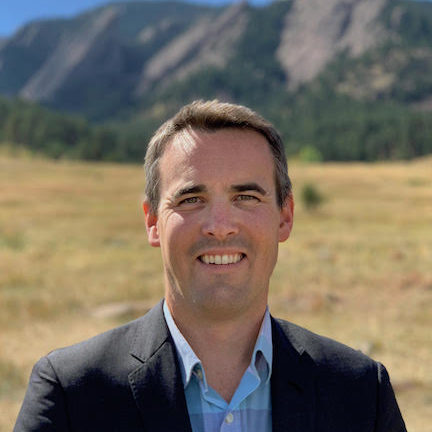
Evan Thomas
Evan Thomas, PhD
CEO / PI
PhD Aerospace Engineering, MPH, MBA. CU Boulder faculty. Lead PI, convergence strategy.
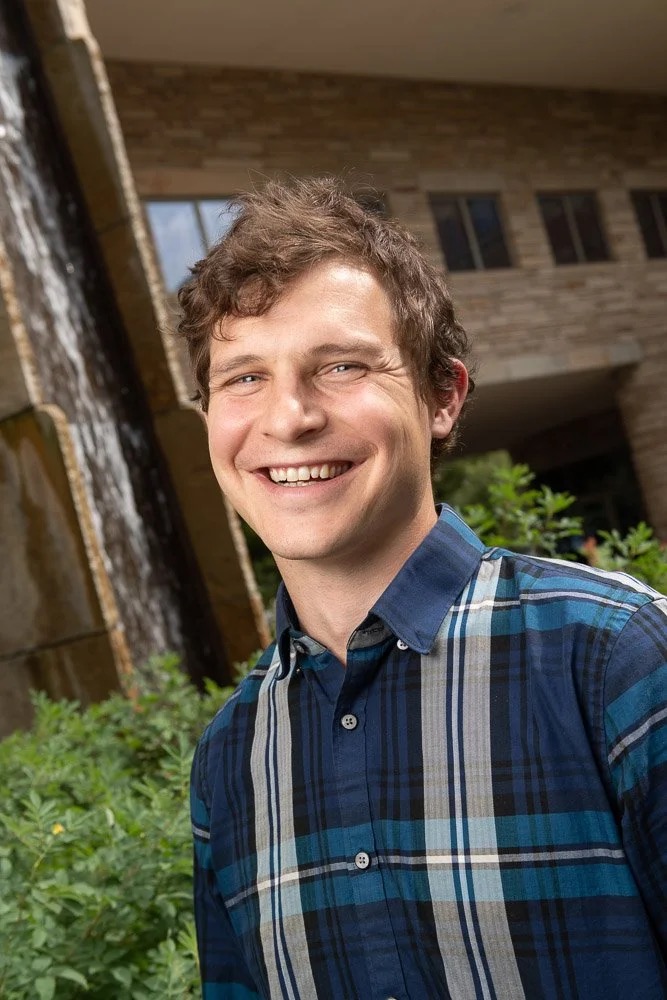
Matt Ross
Matt Ross, PhD
Chief Data Scientist
PhD Ecology, Duke. CSU faculty. ML models, global E. coli dataset curation.
Alex Johnson
Alex Johnson
Chief Strategy Officer
Economics BS, Duke. 20 years energy and environmental markets. Sales, marketing, policy, strategy.
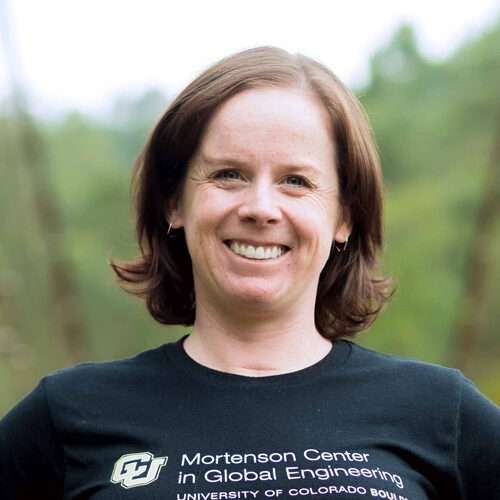
Laura MacDonald
Laura MacDonald, PhD
Int'l Carbon Programs
PhD Johns Hopkins. International carbon credit program design and execution.
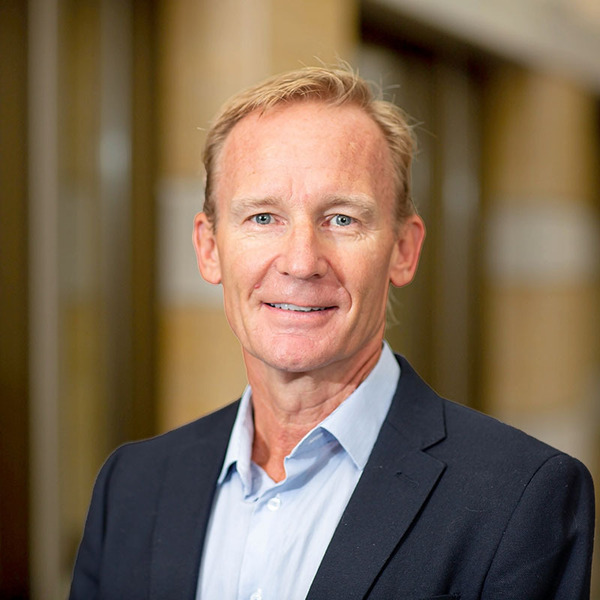
Danny Wilson
Danny Wilson, PhD
CTO
PhD Mechanical Engineering, UC Berkeley. Sensor hardware, firmware, ML pipelines.
Denis Muthike
Denis Muthike, PhD
Geospatial Scientist
PhD CU Boulder. Geospatial analysis, remote sensing, deployment analytics.
Whitney Knopp
Whitney Knopp
Environmental Engineer
PhD candidate, CU Boulder. Lead author on Lume sensor validation manuscript.
John Ecklu
John Ecklu, PhD
Environmental Engineer
East Africa implementation. Carbon market applications to water insecurity.
Jean Ntazinda
Jean Ntazinda
Rwanda Climate Finance
10+ years climate finance. Green Climate Fund, Paris Agreement implementation.
Krister Andersson
Krister Andersson, PhD
Co-PI / Behavioral Science
Professor of Political Science, Notre Dame. Policy design and behavioral economics.
Carlo Salvinelli
Carlo Salvinelli, PhD
Co-PI / Water Treatment
Associate Teaching Professor, CU Boulder. Environmental engineering and water treatment systems.
Fatma Köroğlu
Fatma Köroğlu
PhD Student
CU Boulder. Precision irrigation carbon credit programs in Turkey.
The Challenge

Water Quality Impairment at Scale

4B
People

drink microbially contaminated water

60%
of GDP

threatened by water insecurity

10%
of Emissions

from water management

50%
US Rivers

fail Clean Water Act standards

Root cause: Diffuse watershed processes, not just point sources. Current approaches underutilized due to regulatory uncertainty, measurement challenges, and insufficient financing mechanisms.

Convergence Approach & Intellectual Merit

Three-Part Integrated Framework

A convergence of engineering, ML, behavioral science, environmental chemistry, hydrology, economics, and public policy

📡

Real-Time Sensing

Lume platform: TLF with ML for real-time E. coli estimation. Sub-ppb optical sensitivity. No calibration needed.

  • TLF sensing with gradient-boosted ML models
  • 500+ coincident field samples across 8 installations
  • Submitted manuscript: Knopp et al. 2026
💰

Carbon-Finance Mechanisms

Gold Standard, Verra, and Regen Registry programs. Sensor-verified outcomes link monitoring to monetization.

  • First-ever verified watershed carbon credits (Yahara WINS)
  • Novel application of VM0042 for irrigation efficiency
  • Gold Standard DMRV pilot approved

Policy Co-Design

Colorado SB24-037 directs CDPHE to collaborate on monitoring pilots. Research-to-regulation pathway.

  • First framework coupling sensor data to compliance
  • Comparative national WQT analysis (95% complete)
  • Journal article on pilot archetypes in preparation

Convergence: Policy frameworks create demand for monitoring → Monitoring enables carbon verification → Carbon finance funds watershed restoration

Product

Meet the Lume

Continuous water quality monitoring — for the cost of a single grab sample.

Three interchangeable optical modes: TLF (280/350nm, E. coli), Cl-A (470/680nm, algae/HABs), FDOM (365/480nm, dissolved organics). Plus turbidity and temperature.

Sampling: 30s–24h intervals. Cellular + satellite connectivity. 1-year battery on hourly sampling. Solar or wall charging. No calibration or maintenance required.

Key Applications

  • Drinking water source protection
  • Recreational water & beach advisories
  • Wastewater discharge & CSO monitoring
  • Agricultural return flow monitoring
  • Reservoir and intake monitoring

$200/month — includes device, connectivity, cloud dashboard, API, and firmware updates.

Technology

Hardware & Analytics

Sensor Capabilities

  • TLF: E. coli & microbial contamination (280/350 nm)
  • Cl-A: algal biomass & bloom detection (470/680 nm)
  • FDOM: dissolved organics & nutrient loading (365/480 nm)
  • Integrated turbidity, temperature, GPS
  • No regular calibration or cleaning required

Operations

  • Sampling: 30 sec to 24 hours (remote config)
  • Battery: up to 1 year; solar or wall charging
  • Cellular & satellite connectivity
  • Single integrated unit — no external power or telemetry
  • ML quantification with protected dashboard & API

SiPM Detector Advantage

Only TLF water sensor using a Silicon Photomultiplier — no competitor uses SiPM for tryptophan-like fluorescence.

  • 12,000x responsivity vs photodiode
  • 100,000x+ internal gain
  • 80x lower noise floor
  • ~$130 SiPM vs ~$4,000 PMT — 29,000x min. detectable power
  • < 0.1 ppb detection limit (competitors ~3 ppb)
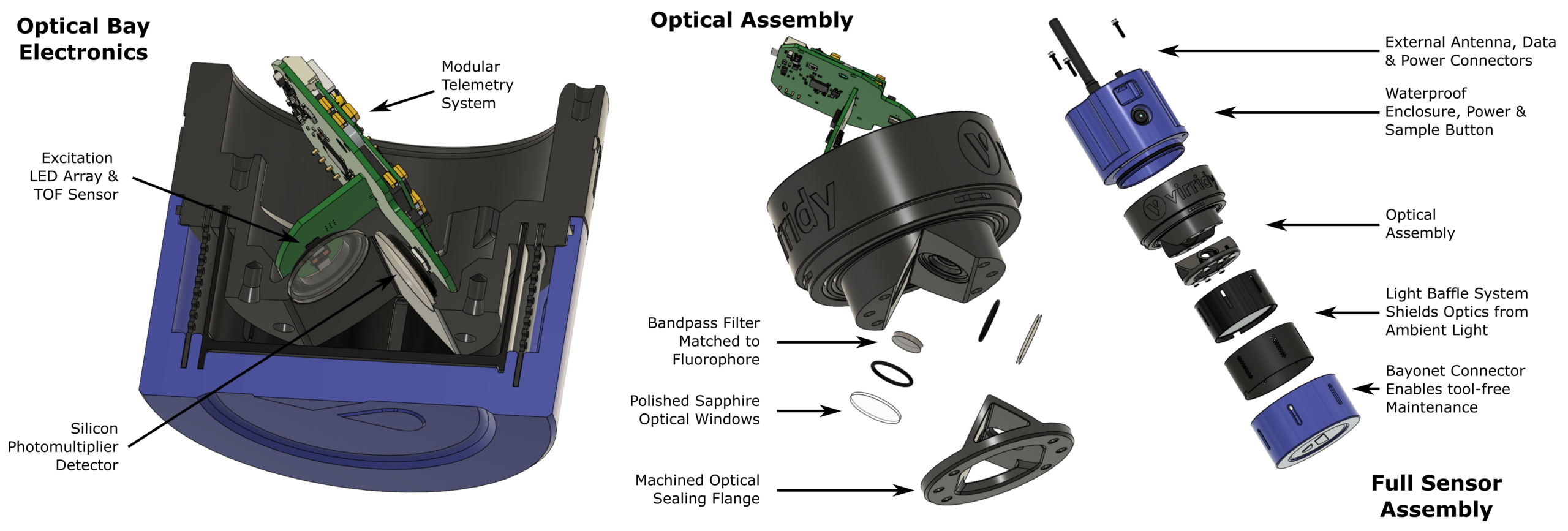
Lume v1.2 exploded technical view
Intelligence

Analytical Features

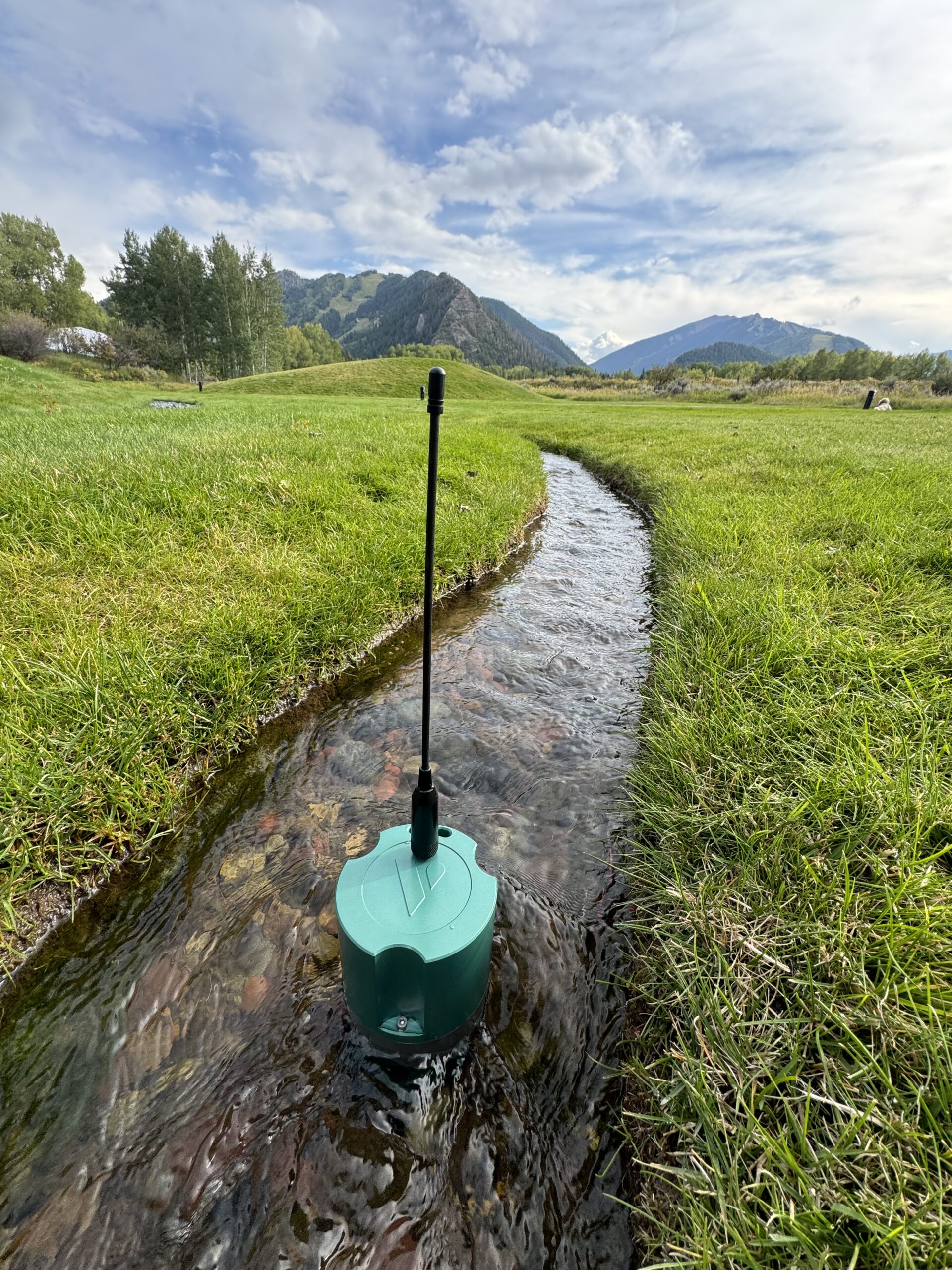
Lume sensor deployed in mountain stream

Adaptive Contamination Detection

The Lume uses machine learning to learn normal conditions and trigger contamination alerts based on learned patterns rather than fixed thresholds.
US Patent 11,506,606 B2 — Bedell, Fankhauser, Sharpe, Wilson & Thomas
Machine learning code

Automated System-State Classification

Time-series data from water infrastructure sensors are analyzed to classify system states and support operational decisions without manual inspection or rule-based logic.
US Patent 11,507,861 B2 — Wilson, Coyle, Thomas & Croshere
Natural waterfall

Natural Waters Application

Gradient-boosted decision tree models achieving 75%+ accuracy across 0–1,000 CFU/100mL, >94% categorical accuracy with site calibration, and 7% MAPE (log-transformed).

Cross-Track Integration: NASA KSC collaboration with Daniel Yeh team — Lume Cl-A (470/680 nm) and TLF (280/350 nm) sensing for continuous monitoring of algae-based water treatment performance.

Sensor Validation

Performance Results

500+ coincident E. coli field samples across 8 installations  |  Submitted: Knopp et al. 2026

75%+
Continuous Accuracy
>94%
Categorical (Site Cal.)
7%
MAPE Log-Transformed
>90%
Bal. Acc. (Seine)
Performance

Drinking Water Classification

The Lume has been validated for drinking water monitoring across chlorinated and unchlorinated supplies. Binary classification at regulatory thresholds of 1 and 10 CFU/100 mL yields 91–92% overall accuracy with Cohen's kappa of 0.82–0.84.

Confusion matrices for binary classification of water quality using sensor predictions versus laboratory-observed E. coli concentrations at two regulatory thresholds.

Performance

Chlorinated Supply Monitoring

The Lume detects chlorine residual presence in treated water supplies with 85% accuracy, distinguishing pre- and post-chlorinated samples.
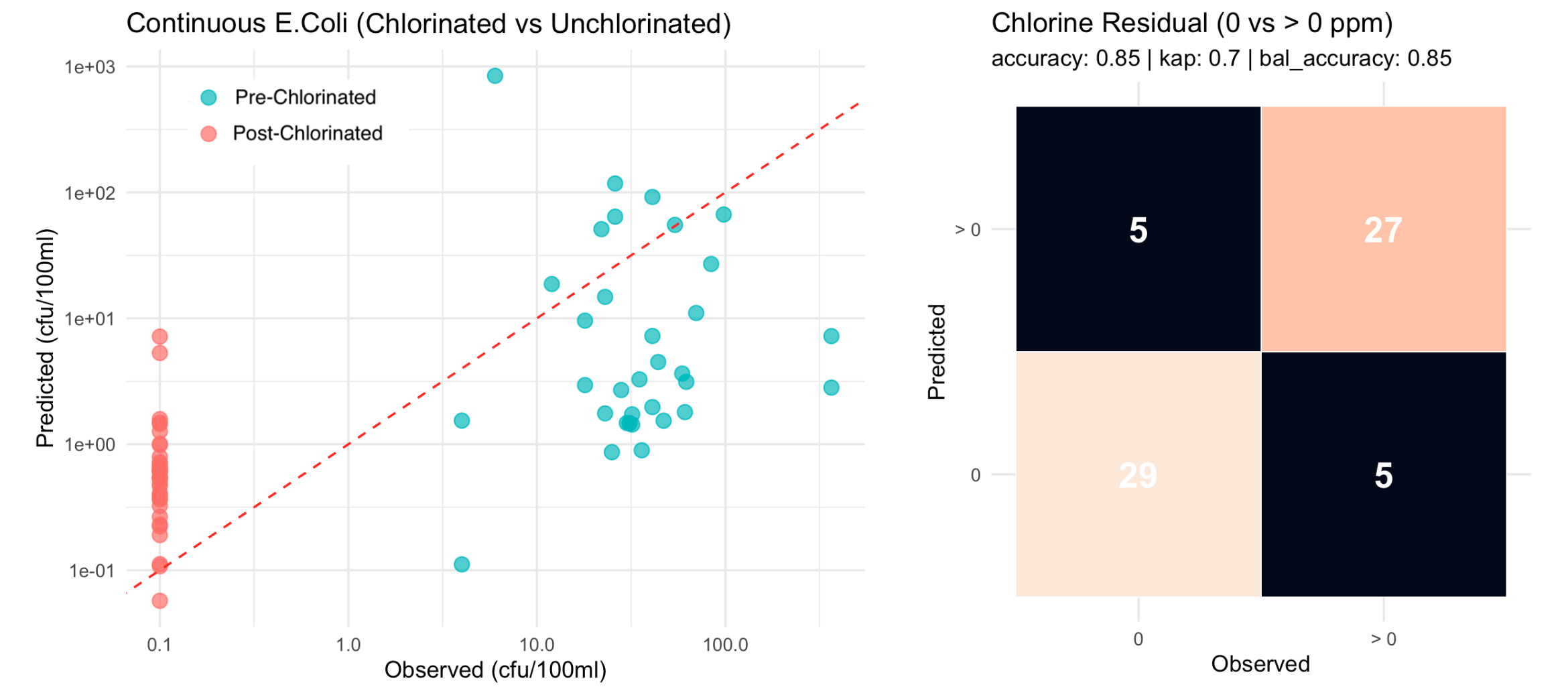
Chlorinated supply monitoring: scatter and confusion matrix

Left: Predicted vs observed E. coli on log axes. Right: Binary classification of chlorine residual presence (accuracy 0.85, kappa 0.70).

Performance

Natural Waters — Global Model

Temporally structured cross-validation across the global dataset. RMSE ranged from 0.55 (training) to 0.63 log units (test), with MAPE below 22% across both splits.

Left: Global dataset cross-validation. Right: Seine River, Paris — binary classification achieving 96.8% accuracy and 94% balanced accuracy using three TLF sensors.

Validation

Lume vs. EPA-Approved Methods

The Lume achieves better agreement with Colilert (R² = 0.861) than Membrane Filtration does (R² = 0.584) — on the same water samples
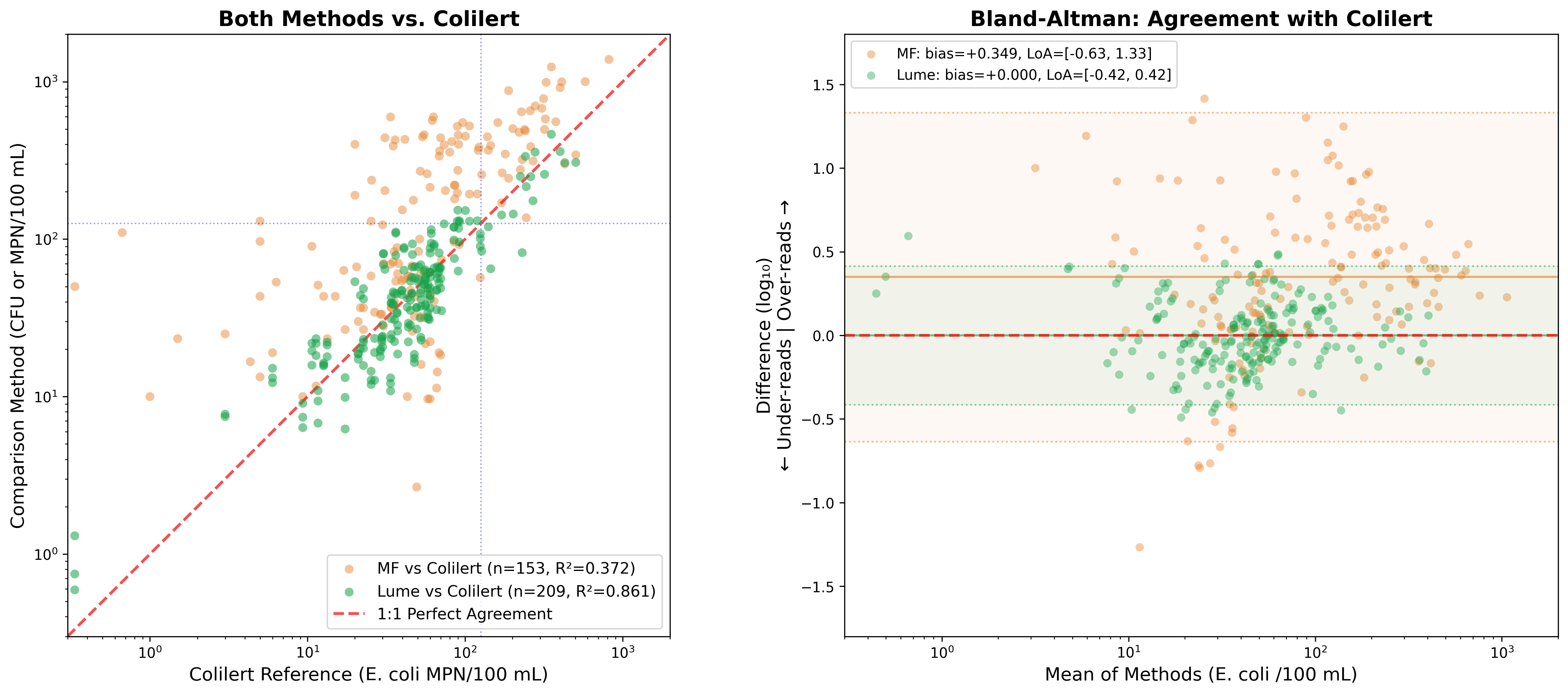
Method comparison: regression and Bland-Altman
Deployment Network & Pipeline

Active Installations & Contract Pipeline

$200/mo SaaS • 12-month minimum • $1,200 COGS (2x recovery Year 1)

Confirmed Revenue
$711K
11 contracts • 66 units • 65% margin
Total Pipeline
$2.2M
16 contracts • 276 units • 76% margin
US Sites Active
16+
across 9 states
International
5
countries

United States

Boulder Creek, CO (City of Boulder)
Chicago, IL (Current / H2NOW)
South Platte & Denver (Denver Water)
Charles River, MA (CRWA)
NASA KSC, FL (Daniel Yeh)
Cleveland, OH
San Diego, CA (EPA/SDSU)
Key West, FL
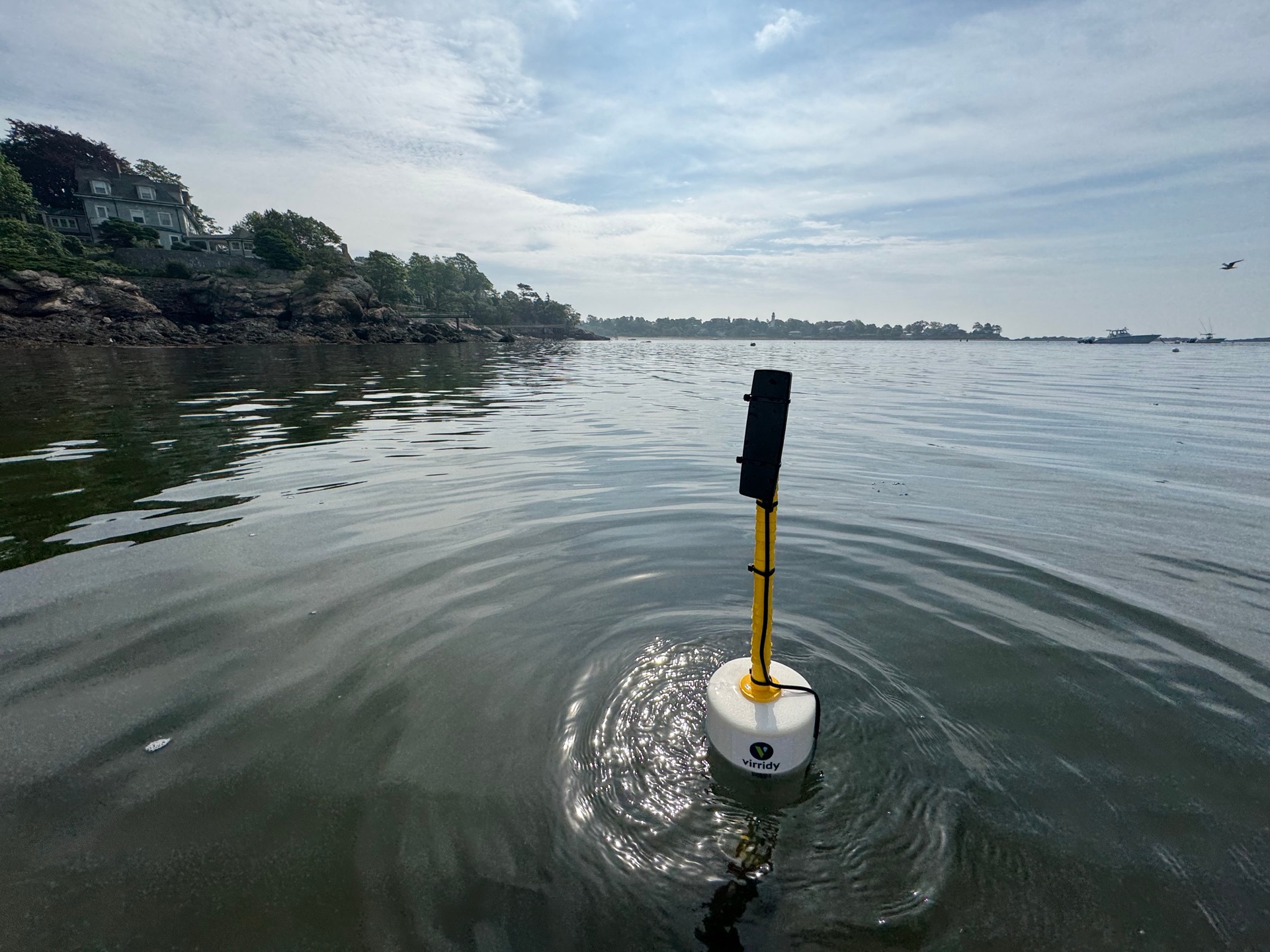
Manchester Bay, MA
Fort Myers & Melbourne, FL
NEON, CO (NSF)
U.S. Air Force (lab visit Apr 2026)

International

Seine/Marne, France (Suez Water)
Thames, UK (British Geological Survey)
Banff, Canada (Bow River Council)
Kenya (MWA)
Rwanda (Amazi Meza)

Strategic Partners

Veralto (Hach, OTT HydroMet, In-Situ)
NSF ASCEND Engine

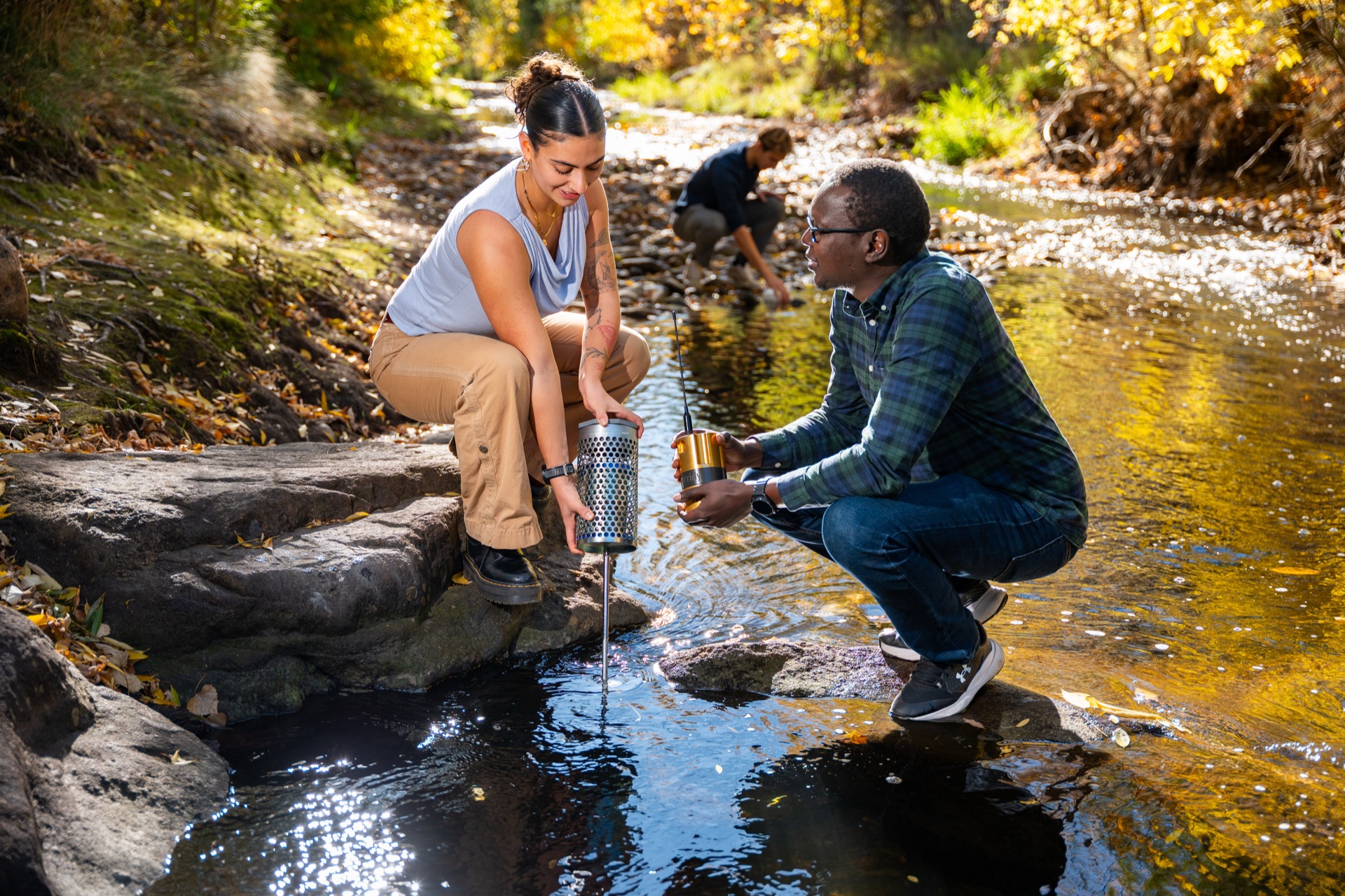
Field Testing the Lume

Researchers deploying the Lume sensor in natural stream environments for real-time E. coli monitoring and validation studies.

Seine River, Paris

Virridy’s Lume sensors monitoring water quality for recreational swimming safety along the Seine River.

Rural Water Access, Kenya

Monitoring borehole water points in arid pastoral regions. IoT sensors verify functionality and usage for carbon credit verification.

Clean Water in Schools

LifeStraw water purifiers monitored by Virridy sensors in classrooms across Kenya — supporting access to safe drinking water and verified carbon credits.

Regulatory

Regulatory & Compliance Pathways

Three parallel tracks advancing the Lume from research instrument to accepted compliance and verification technology.

Colorado — CDPHE

  • SB24-037 enacted with bipartisan support — first-of-its-kind legislation
  • Three regional watershed pilots approved; Longmont advancing
  • City of Boulder partnership for ATP approval
  • 6 TLF sensors at TMDL compliance sites with Colilert validation

EPA — ATP Approval

  • Alternative Test Procedure for continuous microbial monitoring
  • Pathway: City of Boulder → CDPHE → EPA Region 8
  • 500+ coincident field validations, >94% categorical accuracy
  • Screening designation would unlock utility compliance market nationally

Gold Standard — DMRV

  • Digital monitoring, reporting, and verification for drinking water carbon credits
  • Pilot approved under Gold Standard DMRV Programme
  • Deploying in Rwanda and Kenya — June 2026
  • Direct pathway to reducing MRV costs across carbon portfolio
Market

Microbial Sensor Global Market

$5.57B

Global water quality sensor market in 2024, projected to reach $12.9B by 2033 (CAGR ~9%).

200K

Cl-A sensors sold in US in past 10 years. Annual market ~$100M. Microbial is the next frontier.

SensorDescriptionSetupEst. CostAccuracy
Virridy Lume Tryptophan sensor; ML model analysis Single, fully integrated IoT sensor $200/month/site 75%+ accuracy, >94% categorical
Proteus Sonde Multiparameter sonde Requires data logger, site-specific calibration $14K - $24K+ +/- 10 CFU/100mL
Chelsea UViLux Tryptophan, CDOM, BTEX, BOD Not specified ~$5,000 0.01 QSU sensitivity
YSI (Xylem) Chlorophyll only, no tryptophan Multiparameter sonde $4,985+ N/A for TLF
In Situ Inc. FDOM, CDOM, Cl-A, no tryptophan Multiparameter sonde + telemetry ~$10,000 N/A for TLF
Carbon Finance

The Drinking Water Credit Model

Step 1
Clean Water
Deploy water treatment so communities that can’t afford to boil—or that burn firewood to do so—get safe drinking water.
Step 3
Fuel Saved
Actual and suppressed fuel demand is eliminated. Avoided emissions quantified and verified under Gold Standard and Verra.
Step 2
Monitor & Verify
IoT sensors objectively measure usage. Combined with surveys, audits, and water quality testing for rigorous digital MRV.
CO₂CREDIT
Step 4
Carbon Revenue
Avoided emissions generate certified carbon credits. Revenue sustains and expands the clean water service.
Revenue Reinvested in Water Services
Carbon Portfolio

Global Programs

10+ projects across 12 countries — sensor-verified safe water access generating carbon credits
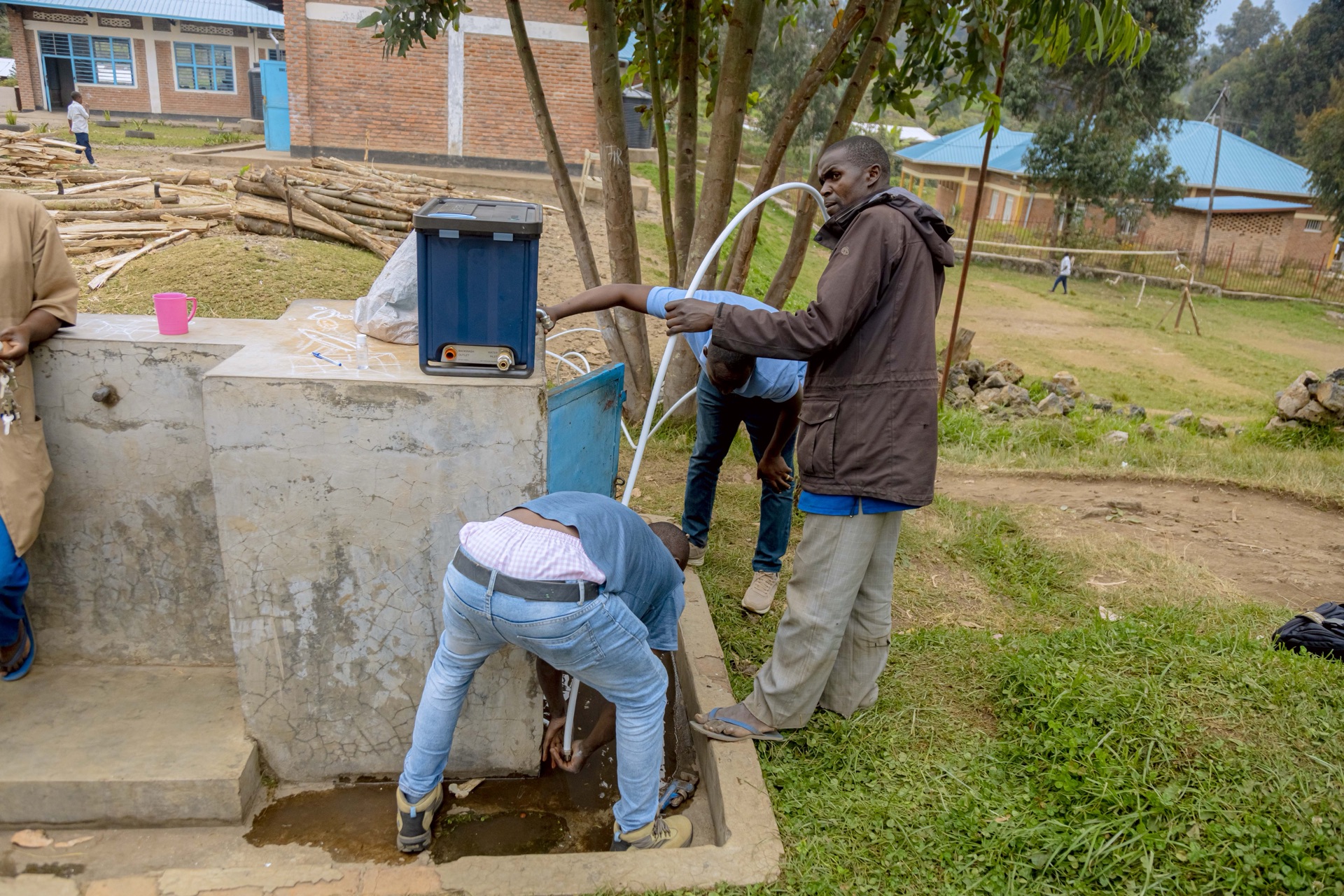
Rwanda

Rwanda — Amazi Meza

600K students. Gold Standard registration. 7,665 credits issued (2024), 33,911 credits (2025).
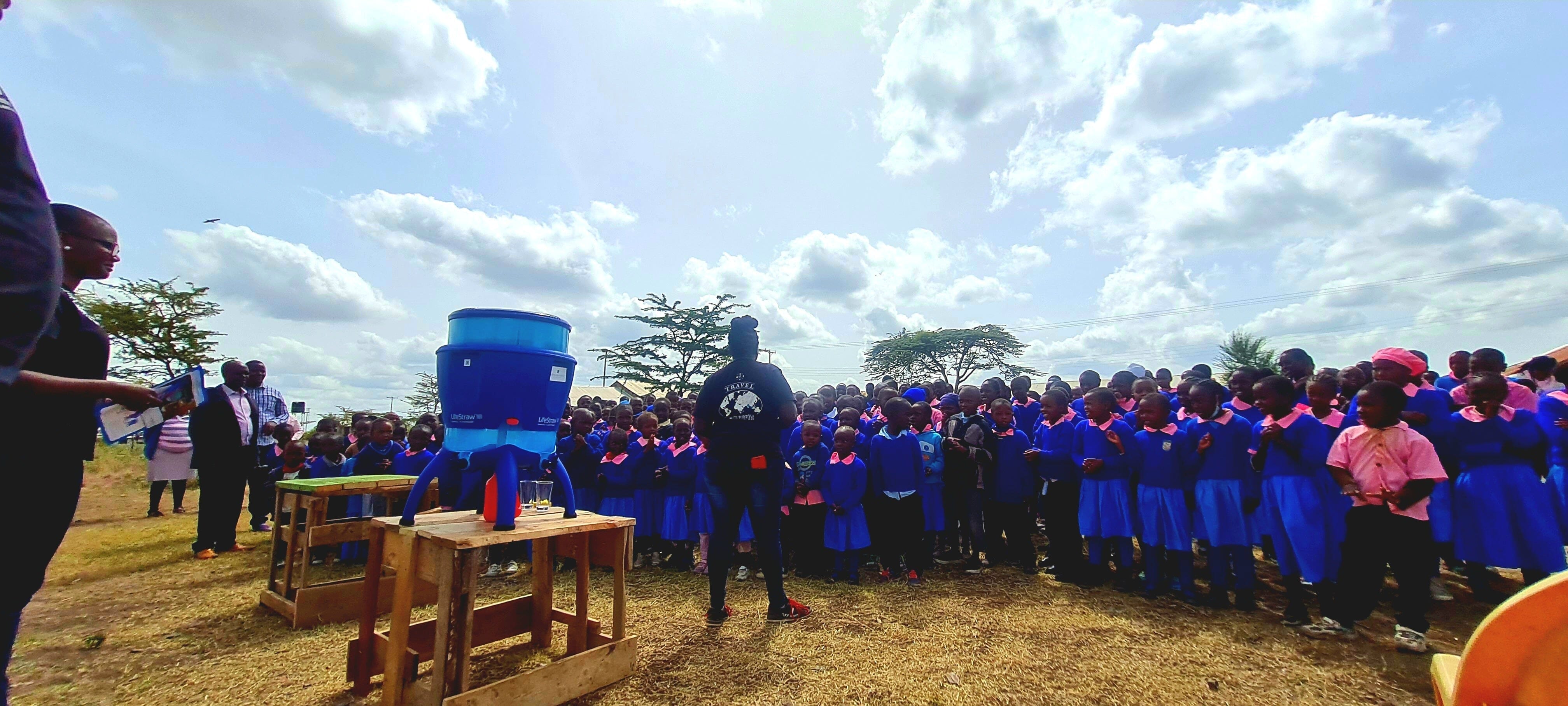
Kenya

Kenya — LifeStraw

3M+ students served. Largest school-based water treatment program globally. 12,384 credits issued (2026).

Tanzania

Tanzania — Water Mission

Community water supply and treatment. 74,000–112,000 credits projected (2026–2030).

29–49%
Diarrhea Reduction
5.6x
Cost-Benefit Ratio
12
Countries

~$17M in credit sales contracts executed to date

Portfolio

High Integrity Water Projects Across Africa

9
Countries
1,180
Monitored Sites
5M+
People by 2030
3M+
Credits by 2030
Carbon Portfolio

Agricultural Programs — US & Turkey

First-Ever

Wisconsin — Yahara WINS

  • First verified watershed carbon credits
  • Regen Registry — 139K hectares
  • 24,143 credits issued (2026)
  • 78K+ tonnes CO2e avoided

Colorado

  • SB24-037 pilot framework
  • CDPHE-approved pilots
  • Sensor-verified watershed monitoring
  • Compliance pathway development

Turkey — Netafim

  • VM0042 methodology — Konya Basin
  • 1,000+ hectares, 3.5 tCO2e/ha/yr
  • Scaling to 10,000 hectares (10x) with Mexico expansion
  • 20,000–200,000 credits projected (2027–2031)
Accomplishments & Traction

Metrics & 2026 Milestones

Key Metrics

MetricTargetActual
Sensor accuracy90%>94%
Field validations500500+ (8 sites)
E. coli dataset10M obs10M+
Carbon credits issuedFirst78K+ tCO2e
Carbon contracts$10M~$17M
Countries912
Lume units produced / sold200 produced, 66 sold ($711K YTD)
Regulatory pilots33 (CDPHE)
Publications3539
US sites1016+

2026 Traction

  • $8.5M equity — Accord Capital & Mortenson Construction
  • $5M NSF Convergence Accelerator; two NSF Engine partnerships
  • $1M NASA Congressional Earmark
  • $8.5M carbon credit contract — PetroChina Singapore
  • $6.5M carbon credit contract — Louis Dreyfus Company
  • $20M carbon fund — Total Impact Capital / Bridges Outcomes ($12M verbal)
  • $20M verbal acquisition offer — Geospace Technologies
  • Veralto (Hach) strategic partnership negotiations
  • Gold Standard DMRV pilot approved
  • SB24-037 enacted; 3 CDPHE pilots approved
  • U.S. Air Force lab visit (April 2026)
  • 2.6M people served; 5M by 2030 target
  • Walton Family Foundation PRI Cohort invitation
  • Moore Foundation philanthropic grant support
IP Portfolio

Patents and Papers

Patents

  • DMRV Fusion Networks (2023, pending) — Drinking Water, In-Stream, Wildfire, Water Quality Prediction & Attribution
  • Alarm Threshold Microbial Fluorimeter — US Patent 11,506,606 B2 (2022)
  • ML Water Service Delivery — US Patent 11,507,861 B2 (2022)
  • Microcomputer Sleep-Mode — US Patent 10,564,701 (2020)
  • Distributed Low-Power Monitoring — US Patent 9,077,783 B2 (2015)

Selected Publications

  • Knopp et al., Continuous in-situ microbial contamination quantification, EarthArXiv, 2026
  • Demaree et al., Sensor Informed Predictive Model for TOC and Nutrients, ES&T Water, 2026
  • Johnson et al., Avoided GHG Emissions from Watershed-Scale Adaptive Management, under review
  • Landon, Johnson & Thomas, WQT Feasibility for SB24-037, under review
  • Ecklu et al., Digital MRV for carbon credit water programs, ES&T Letters, 2025
  • Bedell et al., Continuous fluorescence sensor for fecal contamination, Water Research, 2022
  • Limb et al., Carbon markets for green infrastructure WQT, Comms Earth & Env., 2024
  • 13 publications since 202339 total incl. Nature, Lancet Planetary Health, STOTEN
Broader Impacts

Societal Outcomes

🌍

Environmental

  • Contamination detection in real time
  • Watershed restoration
  • 78K+ tonnes CO2e avoided

Public Health

  • 29–49% diarrhea reduction
  • 5M+ people by 2030
  • 3M+ tonnes of carbon avoided
📊

Scientific

  • 13 publications since 2023
  • 10M+ E. coli observations
  • 2 granted patents + 5 pending

Equity & Cost

  • 180x more data: 720 readings/mo vs 4 grab samples
  • Lume at $200/mo/site replaces costly manual sampling
Partnership Network

Multi-Sector Convergence

Sector Partners
Academic University of Colorado Boulder, Colorado State University (Open Current spin-out)
State Government CDPHE (Colorado Dept. of Public Health & Environment), EPA
Federal NSF, NASA, USAF
Technology In-Situ Inc., Veralto (Hach/OTT), Urban Sky, Blues Wireless
Nonprofit Friends of the Yampa, Millennium Water Alliance
Utilities Municipal water districts and wastewater utilities
Carbon Buyers LDC, PetroChina Singapore, Water Environment Federation, Mortenson Construction
International Netafim, British Geological Survey, City of Paris

Convergence in practice: Partners span academic research, government regulation, private technology, nonprofit implementation, and carbon market demand — all interconnected through the Virridy platform.

Sustainability & Budget

Path to Self-Sustaining Impact

$711K
Lume 2026 YTD
$3M
Projected Carbon Rev. 2026
~$17M
Credit Contracts
$8.5M
Equity Raised
$5M
NSF Award

Dual Revenue Model

  • Lume SaaS: $200/mo — 200 produced, 66 sold
  • Carbon credit programs across 12 countries
  • Proteus displaced by Lume on H2NOW Chicago and Marne River
  • Veralto strategic partnership in negotiation (Hach, OTT, In-Situ)

Competitive Moat

  • YSI/In-Situ measure fDOM — not tryptophan, no E. coli
  • IDEXX Colilert: 18–24 hr — Lume is real-time
  • M&A consolidation: In-Situ ($435M), Chelsea/Covelya ($615M)

Blended Capital Structure

NSF Convergence Accelerator Award Funding
Private Equity Investment $8.5M
Carbon credit contracts $17M+
Debt facility development $20M

NSF Contract Structure

Contract
$185K/mo
9 invoices / $1.665M
CU Boulder
$500K
Open Current
$500K

2030 targets: 12 countries • 5M people • 3M credits  |  Revenue execution directly coupled to project sustainability

Progress

Phase 2 Objectives — 3-Year Roadmap

Year 2 — Sensing
  • 150+ Lume units sold
  • 1,000+ field validations
  • Veralto partnership execution
  • USAF field validation
Year 2 — Carbon Finance
  • 10,000 hectares under management
  • Close $20M fund
  • DMRV Kenya & Rwanda (Jun 2026)
  • $25M+ contracts target
Year 2 — Policy
  • ATP via CDPHE / EPA Region 8
  • Publish WQT analysis
  • SB24-037 national replication
  • EPA screening method pathway
Phase 2, Year 2

Acceleration Plan

Track 1

Scale Sensing

  • 1,000+ validations across 15+ sites
  • 150+ Lume units sold (Y2 target)
  • Site-generalizable E. coli models
  • USAF field validation & procurement
  • Veralto partnership execution
Track 2

Scale Carbon Finance

  • 10,000 hectares (10x current Turkey/Mexico)
  • Tanzania Water Mission credit execution
  • Close $20M fund (Bridges, $12M verbal)
  • DMRV Rwanda & Kenya (June 2026)
  • $25M+ contracts target
Track 3

Translate Policy

  • ATP submitted to CDPHE / EPA Region 8
  • Publish WQT comparative analysis
  • SB24-037 journal article for national adoption
  • Aspen & Walton Accelerator engagement

Risks & Mitigation

RiskStatusMitigation
Manufacturing delaysResolvedSupply chain diversified. Production meeting demand.
Sensor market evolutionAdaptingPivoting to PFAS detection with MIT/Fluorityx partnership.
USDA RCPP not awardedPivotedRedirected to Turkey (Netafim VM0042) and Mexico.
Offtake coverageSecuredAll offtake contracted through 2031.
Partner Testimonials

External Partners

🏛

Sam Malloy

NSF ASCEND Engine

NSF Engine partnership alignment, convergence research integration, and co-investment in water systems innovation.

🔬

Christel Valentine

Veralto (Hach / OTT HydroMet)

In discussion — strategic partnership for distribution through Hach and OTT HydroMet channels. Market access and co-development.

💵

John Simon

Total Impact Capital

$20M carbon credit investment fund development. Bridges Outcomes Partnerships lead. Financing mechanisms for scale.

🏗

Michael Lawlor

City of Boulder Utilities

Lume deployment on Boulder Creek as paying customer. ATP approval pathway via CDPHE and EPA Region 8.

virridy.com
Virridy

Measuring, Mitigating, and Financing
Watershed Solutions

NSF Convergence Accelerator — Track: Future Water Systems — Award 24C0011

12
Countries
13
Publications
5M+
People by 2030
3M
Credits by 2030
7
Patents / Pending
Monitor  |  Earn  |  Protect

virridy.com  •  evan.thomas@virridy.com