

Project Overview
This project reflects an integrated convergence framework combining continuous environmental sensing, machine learning analytics, regulatory co-design, and carbon-finance mechanisms to address water quality and climate challenges simultaneously. The approach links real-time microbial water quality monitoring with carbon credit generation from drinking water treatment, precision irrigation, and watershed restoration programs—creating financing mechanisms that fund environmental improvements while generating verified, tradeable emissions reductions. The Virridy Lume sensor platform provides continuous in-situ measurement of tryptophan-like fluorescence (TLF), chlorophyll-a, and fluorescent dissolved organic matter (FDOM), operating autonomously with up to one year of battery life, no regular calibration or cleaning, and cellular/satellite data reporting at intervals from 30 seconds to 24 hours. Field validation across 500+ coincident samples has demonstrated >94% categorical accuracy for E. coli estimation with site-specific calibration, 7% MAPE in log-transformed concentration space, and >90% balanced accuracy on the Seine River in Paris. The Lume uses a Silicon Photomultiplier (SiPM) detector that provides significantly greater sensitivity than competing photodiode-based instruments, at $200/month versus $5,000–$30,000 for legacy instruments.
The project currently operates across twelve countries—the United States, Canada, Rwanda, Burundi, Democratic Republic of Congo, Madagascar, Kenya, Tanzania, Turkey, France, the United Kingdom, and Mexico—with programs spanning drinking water treatment, precision irrigation, and watershed restoration. Carbon credits are generated and verified under Gold Standard, Verra VCS (VM0042), and Regen Registry methodologies, with projections of over 3 million credits and 5 million people reached by 2030. See virridycarbon.com for program details and thelume.ai/research for sensor validation data.
Intellectual Merit
The project advances three distinct research frontiers. First, we developed the Lume—the only water quality sensor using Silicon Photomultiplier (SiPM) detection for tryptophan-like fluorescence—and validated it across 500+ coincident field samples achieving >94% categorical accuracy for E. coli estimation. Second, we built and are scaling a global carbon credit portfolio spanning drinking water treatment programs across six African countries (Rwanda, Kenya, Burundi, DRC, Madagascar, Tanzania), precision irrigation with Netafim in Turkey and Mexico under Verra VM0042, and watershed restoration in the United States—including the first-ever watershed carbon credit issuance through Regen Registry. Third, we are advancing regulatory acceptance of novel sensing and carbon verification technologies: we enacted state legislation (Colorado SB24-037) directing CDPHE to collaborate on water quality trading pilots incorporating climate finance; we are working with CDPHE and EPA Region 8 toward regulatory approval of the Lume as an accepted compliance monitoring instrument; and we are collaborating with the Gold Standard to approve the Lume as a digital measurement, reporting, and verification (DMRV) technology for carbon credit programs.
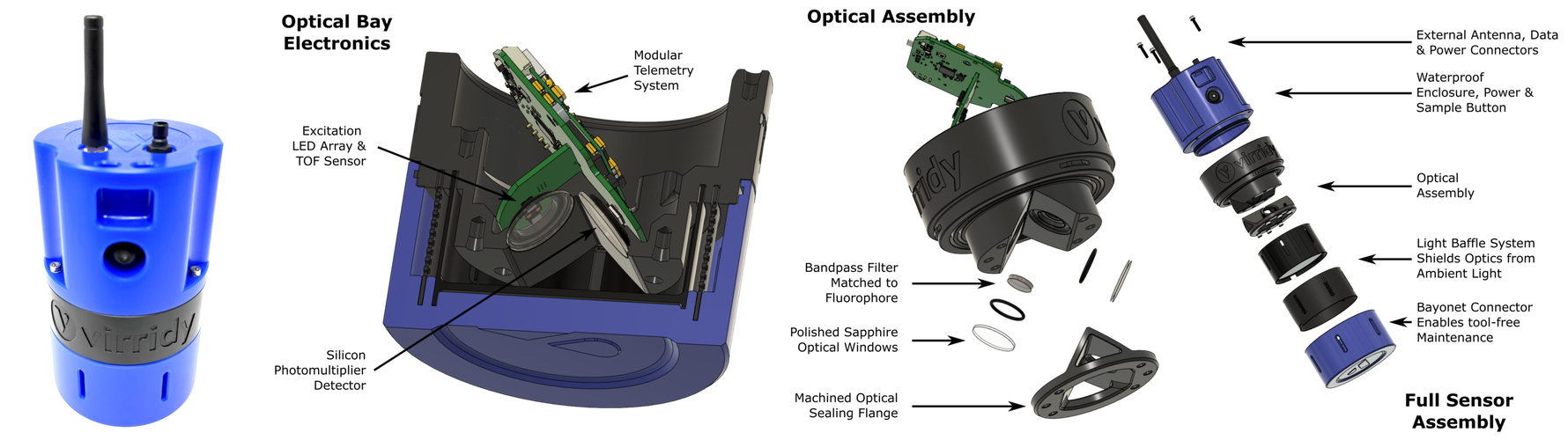
The sensing component advances environmental monitoring science through development of a low-cost, autonomous IoT sensor platform for continuous microbial water quality monitoring. The Lume operates unattended for up to one year on battery power, reports data via cellular or satellite connectivity, requires no regular calibration or cleaning, and costs $200/month versus $5,000–$30,000 for legacy instruments—enabling dense, always-on sensor networks at scales previously impractical. The underlying hardware employs a Silicon Photomultiplier (SiPM) detector that provides significantly greater sensitivity than photodiode-based alternatives at a fraction of the cost of conventional PMTs. The underlying sensing approach is protected by U.S. Patent 11,506,606 and U.S. Patent 11,507,861, with five additional patent applications pending. Detailed sensor validation results are presented in the Accomplishments section below (Figures 6–9).
A second intellectual contribution lies in the development of novel carbon finance methodologies for the water sector. The project team pioneered the methodology for generating carbon credits from drinking water treatment—developing the first programs globally to link safe water provision with verified emissions reductions under Gold Standard certification. This work extends to life-cycle accounting frameworks that quantify emissions avoided through infrastructure substitution, including attributional life-cycle assessment of a watershed adaptive management program that demonstrated verified avoided emissions over a 20-year project life (Johnson et al., 2026), and precision irrigation programs generating credits under Verra VM0042.
A third contribution is the integration of policy design, regulatory engagement, behavioral science, and market mechanisms into environmental engineering research. The project team advanced Colorado SB24-037 into law, directing CDPHE and the state universities to evaluate green infrastructure for alternative compliance and establish up to three watershed pilot programs. Building on this, the team is working directly with CDPHE and EPA Region 8 toward regulatory approval of the Lume as an accepted compliance monitoring instrument for water quality, and collaborating with the Gold Standard to approve the Lume as a digital measurement, reporting, and verification (DMRV) technology for carbon credit programs—bridging the gap between novel sensing technology and the regulatory and certification frameworks required for real-world adoption. A comprehensive comparative analysis of water quality trading programs across multiple states (Landon, Johnson & Thomas, 2026) demonstrates that institutional clarity, enforceability, conservative credit quantification, and financing mechanisms that account for long time horizons are primary determinants of program success. Complementary research on behavioral barriers to nature-based solutions (Demaree, Johnson, Andersson & Thomas, 2025) and the application of voluntary carbon markets to global water security (Ecklu et al., 2024) further advances the convergence of policy, behavioral science, and market design.
Broader Impacts
The project produces measurable environmental, societal, economic, and public-health benefits across multiple geographic contexts. Peer-reviewed randomized controlled trials of the project’s water treatment programs have demonstrated 29–49% reductions in childhood diarrhea, with a cost-benefit ratio of 5.6x across health, livelihood, and environmental dimensions.
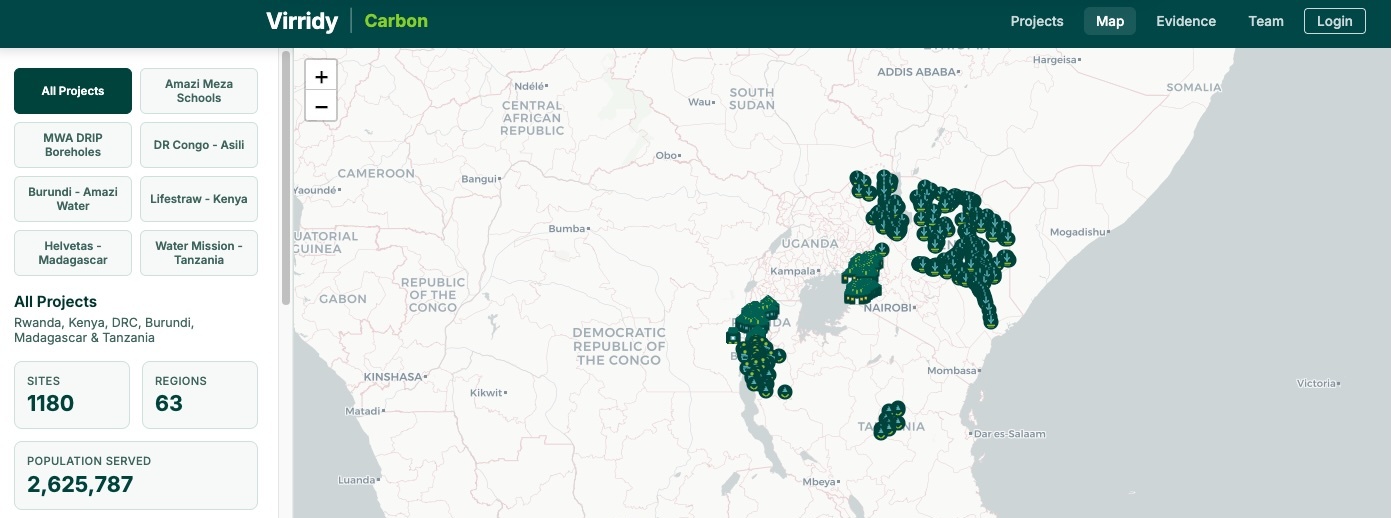
Carbon-financed water programs across six African countries (Rwanda, Kenya, Burundi, DRC, Madagascar, Tanzania) currently serve over 2.6 million people across 1,180 monitored sites (Figure 2), with projections exceeding 5 million by 2030. In Turkey, precision irrigation programs cover over 1,000 hectares, reducing emissions by 3.5 tCO2e/hectare annually. In Wisconsin, the Yahara WINS program across 139,000 hectares produced the first-ever verified watershed carbon credit issuance.
The project produces large-scale scientific infrastructure including a global E. coli database exceeding 10 million bacterial coliform observations and 13 publications since 2020 (10 published, 3 submitted/in review) in journals including Nature Communications, Science of the Total Environment, Water Research, and ES&T Water. Two granted U.S. patents (11,506,606 — Alarm Threshold Microbial Fluorimeter; 11,507,861 — Machine Learning Techniques for Improved Water Service Delivery) and five pending patent applications protect the core intellectual property.
The Lume’s economic model also advances accessibility. Conventional grab-sample testing using IDEXX Colilert costs approximately $19 in consumables plus technician labor and vehicle costs per sample, with 18–24 hour time to result. At a typical configuration of 24 readings per day, the Lume generates over 700 data points per month per site at $200/month—orders of magnitude more temporal resolution than weekly grab sampling at comparable or lower total cost, while capturing transient contamination events that periodic sampling misses entirely.
Team
The project team is deliberately structured to reflect a convergence model that integrates expertise from multiple disciplines: instrumentation engineering, machine learning, environmental chemistry, hydrology, watershed science, behavioral science, economics, public policy, and climate finance. This multidisciplinary configuration ensures that scientific discovery, technology development, policy implementation, and market deployment proceed simultaneously rather than sequentially. Leadership is provided by Principal Investigator Evan Thomas, PhD, Professor of Environmental Engineering and Aerospace Engineering, CEO and founder of Virridy, and Director and Endowed Chair of the Mortenson Center in Global Engineering and Resilience at the University of Colorado Boulder (PhD Aerospace Engineering, MPH, MBA; former NASA civil servant). The executive team includes Danny Wilson, PhD (CTO; PhD Mechanical Engineering, UC Berkeley; Fulbright and NSF Fellow), Alex Johnson (Chief Strategy Officer; former VP at The Freshwater Trust; $40M+ in water quality trading credits sold), and Laura MacDonald, PhD (International Carbon Programs Director; PhD Geography and Environmental Engineering, Johns Hopkins University). Co-Investigators include Matt Ross, PhD (Associate Professor of watershed science, Colorado State University; Founder and CEO of OpenCurrent LLC; PhD Ecology, Duke), Krister Andersson, PhD (Professor of Political Science, University of Notre Dame; behavioral science and policy design), and Carlo Salvinelli, PhD (Associate Teaching Professor, CU Boulder; environmental engineering and water treatment systems). Research staff include Whitney Knopp (Environmental Engineer; PhD candidate, CU Boulder; lead author on the Lume sensor validation manuscript) and John Ecklu (Environmental Engineer; East Africa implementation and carbon market applications). Key partnerships are summarized in Table 1.
| Table 1. Partnership Network | ||
|---|---|---|
| Sector | Partner | Role |
| Academic | University of Colorado Boulder, Colorado State University (Open Current spin-out) | Research + modeling |
| State Government | CDPHE, EPA Region 8 | Regulatory integration |
| Federal | NSF, NASA, U.S. Air Force | Funding + testing |
| Technology | In-Situ Inc., Urban Sky, Blues | Hardware + connectivity |
| Nonprofit | Friends of the Yampa, MWA | Community implementation |
| Carbon buyers | Louis Dreyfus Company, PetroChina Singapore, Water Environment Federation, Mortenson Construction | Credit purchases |
| International | Netafim, BGS, City of Paris | Programs + pilots |
| Utilities | Boulder, Denver, Madison + others | Pilot implementation |
Intellectual property includes two granted U.S. patents—11,506,606 (Alarm Threshold Microbial Fluorimeter) and 11,507,861 (Machine Learning Techniques for Improved Water Service Delivery)—and five pending patent applications covering DMRV fusion networks, advanced sensing modalities, and related technologies.
Project Accomplishments to Date and Plan for Phase 2, Year 2
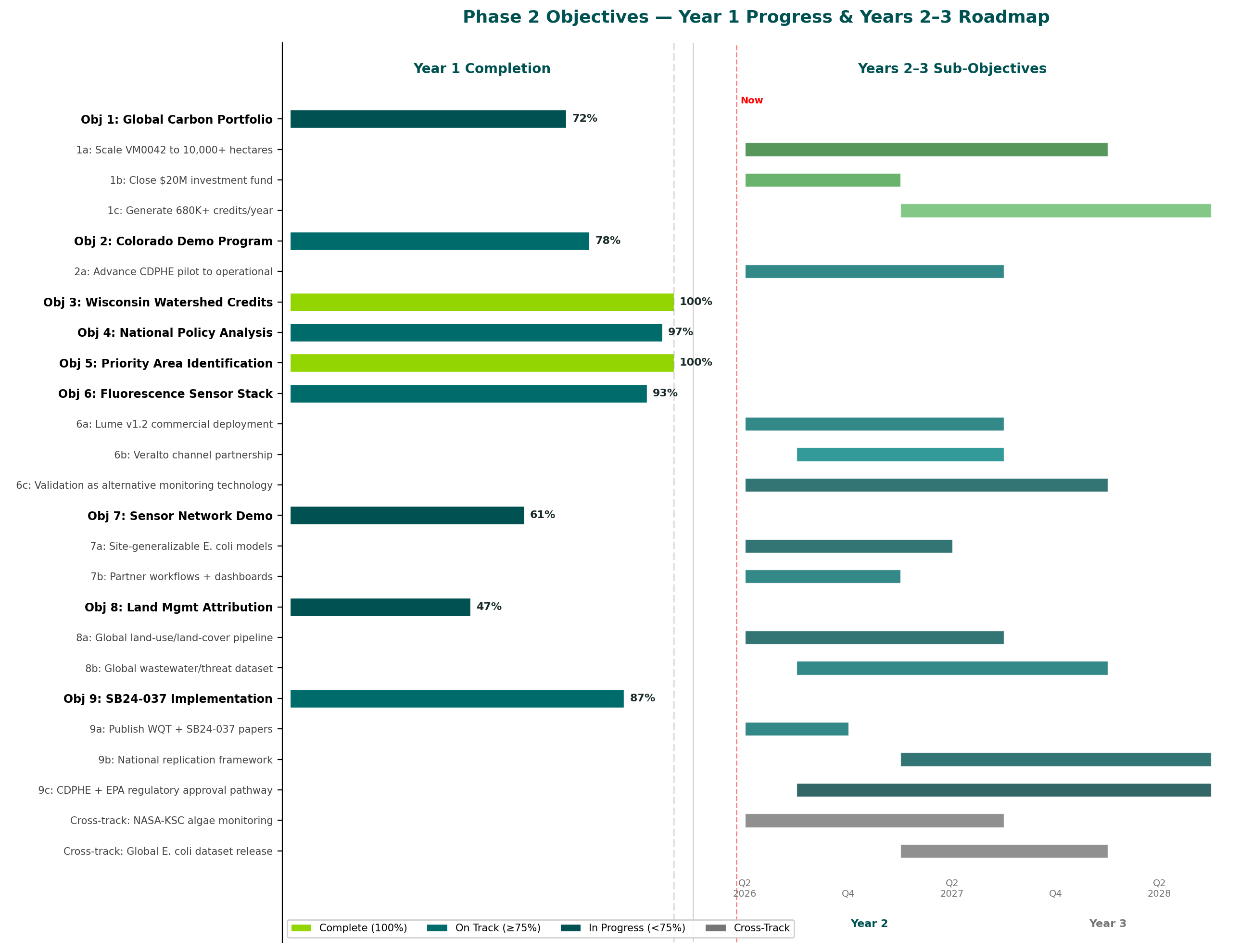
Across Phase 2 Year 1, progress has continued along all nine objectives (Figure 1). On the sensing and technology front (Objectives 6–8), the team built and tested the Lume v1.1 sensor hardware, collected more than 500 coincident field samples comparing sensors to lab E. coli measurements across eight installations, and developed machine-learning models achieving 70–80% categorical accuracy and 15–30% log error rates. Laboratory testing demonstrated consistent TLF detection through turbidity of 0–500 NTU. The global E. coli dataset has reached over 10 million observations with more than 8 million passing quality checks. A manuscript has been submitted reporting sub-ppb sensitivity and greater than 90% balanced accuracy on the Seine deployment. In total, the convergence team has published 10 peer-reviewed papers and submitted 3 additional manuscripts (2 under review, 1 preprint) since 2023, spanning sensor validation, carbon finance, life-cycle assessment, water quality trading policy, and behavioral science (see Publications Cited).
On deployment and market traction, the Lume sensor network is expanding rapidly across domestic and international sites. Active deployments and partnerships include: Suez Water and the City of Paris on the Seine and Marne Rivers; the British Geological Survey on the Thames River (UK); EPA and San Diego State University at Imperial Beach, California; the Indian River Lagoon with NASA Kennedy Space Center and Marine Resources Council (Florida); Current on the Chicago River; the Charles River Watershed Association in Boston; the Bow River Watershed Council in Banff, Canada; the Millennium Water Alliance in Kenya; and Virridy’s own Amazi Meza program in Rwanda. City of Boulder Utilities is a paying Lume customer, with additional contracted deployments underway with Denver Water and the City of Denver, Manchester Bay (Manchester by the Sea, MA), and Fort Myers, FL. The U.S. Air Force has confirmed intent to purchase 1–2 Lume v1.2 devices, with USAF personnel visiting the Virridy lab in April 2026. Channel partner discussions continue with Suez (Veolia) and OTT Hydromet.
The project’s cross-track integration focus is a collaboration with Daniel Yeh’s team and colleagues at NASA Kennedy Space Center, using Virridy’s Lume sensors to track algae-based water treatment performance both pre- and post-processing. This work leverages the Lume’s chlorophyll-a (470/680 nm) and TLF (280/350 nm) sensing modes to provide continuous, real-time monitoring of treatment efficacy in systems that use algae for nutrient removal and water reclamation—a direct convergence between the project’s sensing technology and NASA’s water treatment research.
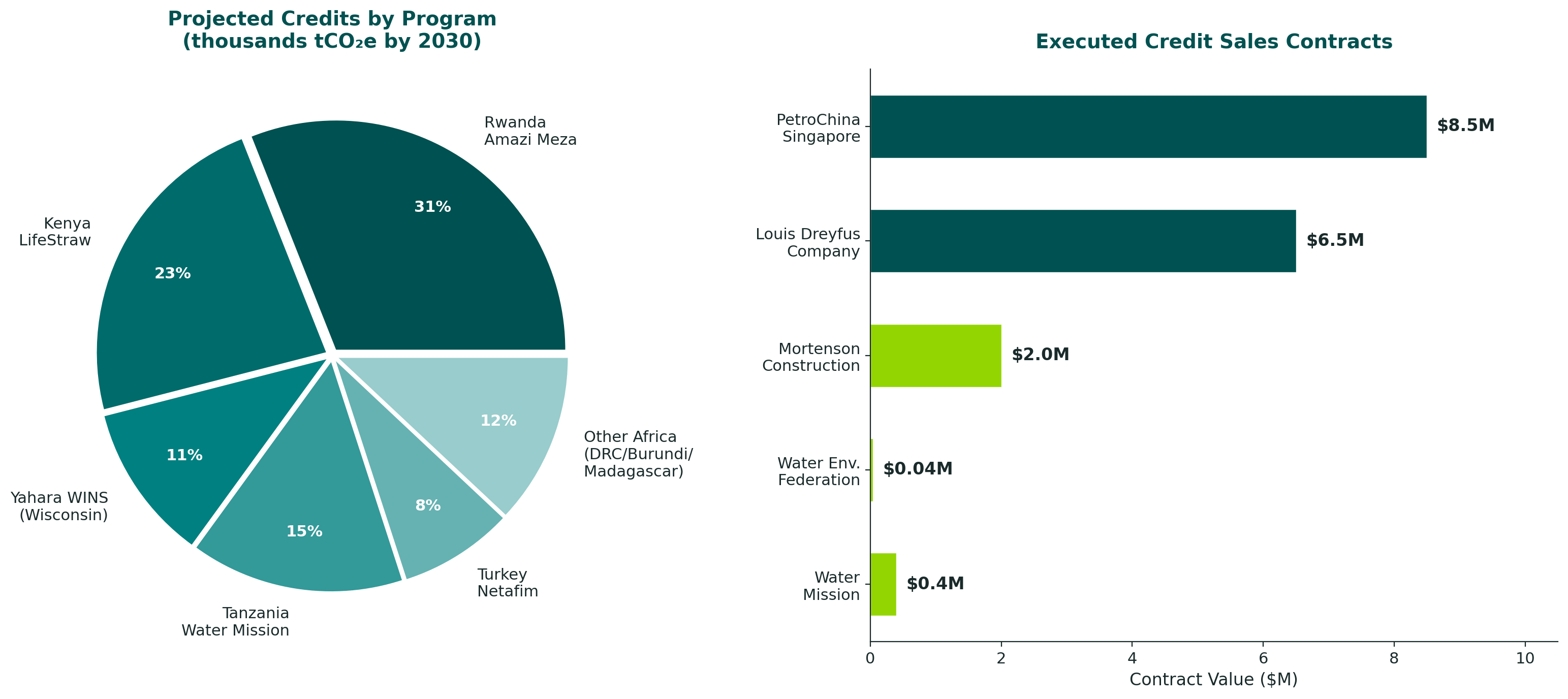
The project has signed credit sales contracts (Figure 3) totaling approximately $17M (minimum, with additional upside sharing and option agreements) in projected revenue across Gold Standard drinking water credits and Verra VM0042 irrigation-based credits. Louis Dreyfus Company and PetroChina Singapore have contracted to purchase credits constituting the majority of this revenue, with additional purchases from the Water Environment Federation ($10K initial to offset WEFTEC, expected to increase after WEFTEC 2026) and Mortenson Construction. All offtake is contracted through 2031.
Verified credit issuances to date total over 78,000 tCO2e across multiple programs: Amazi Meza Rwanda, LifeStraw Kenya, and Yahara WINS Wisconsin. Projected issuances across the full portfolio—spanning drinking water treatment in six African countries, precision irrigation with Netafim in Turkey and Mexico, and watershed restoration in Wisconsin and Colorado—are expected to exceed 680,000 credits annually by 2030.
Key milestones completed include: Government of Rwanda Corresponding Adjustment Letter of Authorization; Turkey irrigation efficiency PDD listing under Verra; first-ever verified watershed carbon credit issuance under Regen Registry methodology; and registration and carbon credit generation from seven programs in six countries in East Africa. The team is scaling VM0042 farmer recruitment in Turkey and Mexico toward a target of over 10,000 hectares (10x the current Konya Basin program), and developing a $20M carbon credit investment fund with Total Impact Capital ($12M in verbal commitments secured, led by Bridges Outcomes Partnerships).
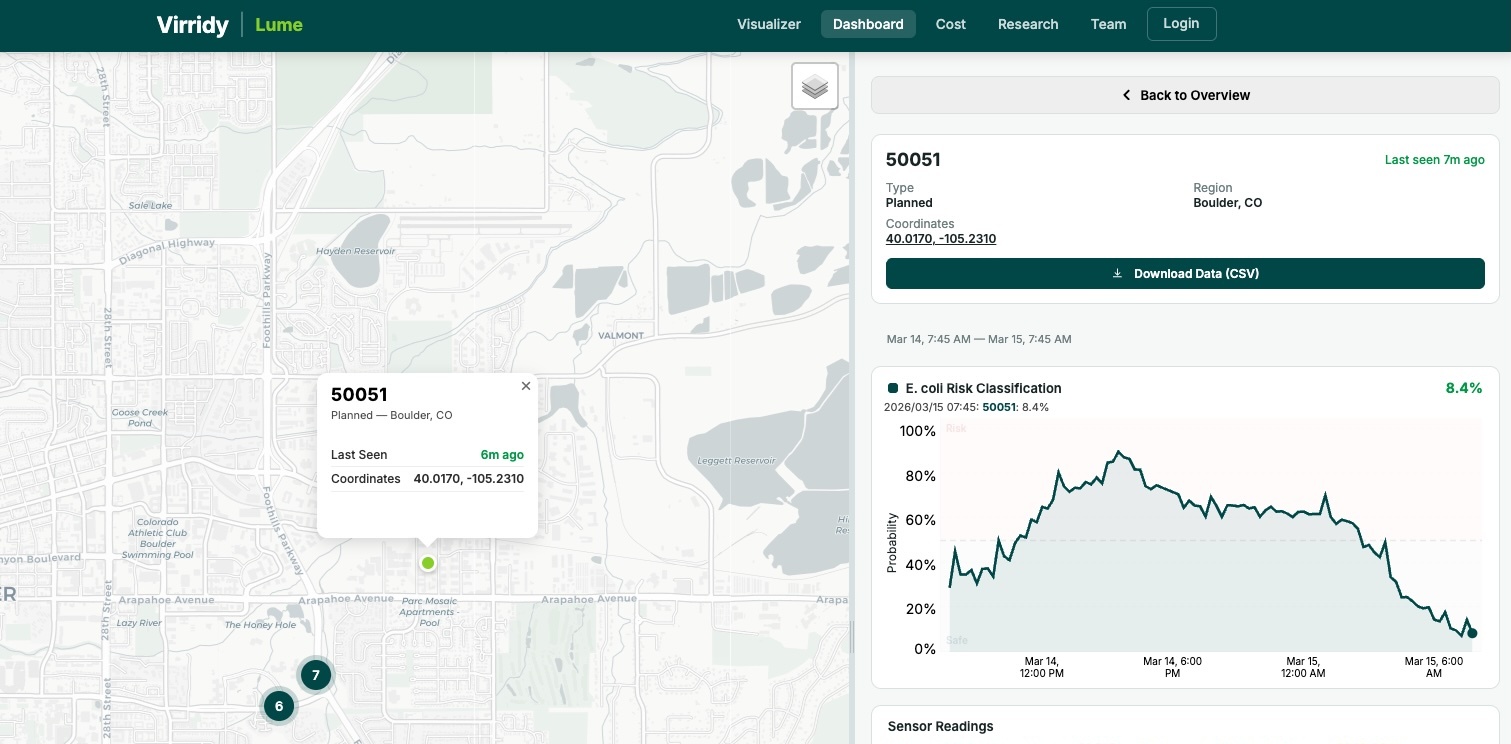
The Lume is the only TLF sensor that outputs quantified E. coli risk estimates rather than raw fluorescence units (Figures 4 and 5), using gradient-boosted machine learning models trained on 500+ coincident field samples. It requires no regular calibration or cleaning, operates for up to one year on battery, integrates cellular and satellite IoT connectivity with a cloud dashboard, and is priced at $200/month versus $5,000–$30,000 for competing instruments. The only direct competitor—Proteus Instruments (UK, ~$561K annual revenue)—sells a $30,000 sonde that is significantly larger, heavier, and achieves lower TLF sensitivity and E. coli accuracy. Proteus has been displaced by the Lume on the H2NOW platform in Chicago and on monitoring of the Marne River in France by the University of Paris.
Sensor validation results for drinking water and natural water applications are presented below (Figures 6–9).
Drinking Water
Binary classification at regulatory thresholds
Chlorinated supply monitoring
Natural Waters
Local model — Boulder Creek, Colorado
Global model — multi-site cross-validation & Seine River, Paris
The project team advanced state legislation SB24-037, which was enacted in Colorado with bipartisan support, enabling watershed pilot programs that integrate green infrastructure with water quality trading and climate finance. CDPHE approved three regional pilots and a three-year implementation timeline, with one discharger now advancing toward pilot implementation. The comparative analysis of national water quality trading best practices (Landon, Johnson & Thomas, 2026) is 95% complete and will serve as a replicable framework for other states. National engagement continues through the Aspen National Water Strategy and the Walton-backed Resilience Accelerator.
A central Year 2–3 priority is pursuing EPA designation of TLF-based continuous monitoring as an approved screening method. With 500+ coincident field validations, >94% categorical accuracy, and the SB24-037 Colorado pilot framework, the project has assembled the strongest evidence base for TLF screening approval of any sensor platform globally. The initial pathway for alternative testing protocol approval will be pursued through the City of Boulder Utilities and CDPHE, with EPA Region 8 as the target regulatory audience. Even a screening method designation—short of full compliance approval—would unlock an order-of-magnitude increase in the addressable market by enabling utilities and regulators to formally incorporate continuous TLF monitoring into compliance and decision-making workflows.
The Gold Standard Foundation has approved the Virridy Lume as a digital MRV (DMRV) pilot under its DMRV Programme. The pilot integrates the Lume into Virridy’s institutional water treatment programs to continuously monitor water filter use, estimate treated water volume, and assess microbial water quality at the point of consumption—digitizing monitoring, reporting, and verification activities currently performed through periodic manual water sampling. The Lume’s tryptophan-like fluorescence measurements and machine learning models classify E. coli contamination risk into WHO risk categories, with automated cloud-based reporting providing transparent, auditable digital records to support third-party verification. Virridy will deploy this DMRV pilot in the Amazi Meza school water treatment program in Rwanda (GS12239) and in Kenya through the DRIP borehole monitoring program beginning June 2026, representing a direct pathway to reducing MRV costs while increasing verification rigor across the drinking water carbon credit portfolio.
Table 2 summarizes the current risk profile and mitigation strategies.
| Table 2. Risk Profile and Mitigation | ||
|---|---|---|
| Risk | Status | Mitigation |
| Manufacturing delays/tariffs | Resolved | Lume v1.2 received and in testing |
| Cl-A/FDOM market competition | Monitoring | Focus on TLF microbial-risk product; evaluating adjacent sensing modalities |
| USDA RCPP not awarded | Pivoted | Direct implementation via Netafim Turkey/Mexico |
| Partner sensor data tracking | In progress | Structured tracking processes being designed |
| Offtake contract coverage | Secured | All offtake contracted through 2031 |
Table 3 summarizes progress against key project metrics.
| Table 3. Metrics for Project Success | |||||
|---|---|---|---|---|---|
| Metric | Year 1 Target | Year 1 Actual | Status | Year 2 Target | Year 3 Target |
| Sensor categorical accuracy | 90% | >94% (site calibrated) | Exceeded | >90% site-generalizable | >90% across all water types |
| Coincident field validations | 500 | 500+ across 8 sites | Met | 1,000+ across 15+ sites | 2,000+ across 25+ sites |
| Global E. coli dataset | 10M observations | 10M+ (8M+ QC passed) | Met | 15M observations | 20M observations |
| Watershed carbon credits | First issuance | First-ever issuance achieved | Met | Second issuance cycle | Colorado pilot issuance |
| Carbon credit contracts | $10M | $17M+ executed | Exceeded | $25M+ executed | $35M+ executed |
| Countries operating in | 9 | 12 | Exceeded | 14+ | 18+ |
| Regulatory pilots approved | 3 | 3 (CDPHE) | Met | 1+ pilot in motion | EPA screening method filed |
| Peer-reviewed publications (since 2023) | 10 | 13 | Exceeded | 18+ | 25+ |
| US deployment sites | 10 | 16+ active/planned | Exceeded | 30+ | 50+ |
| Lume units sold | — | 60 | New | 150+ | 300+ |
| Gold Standard DMRV approval | — | Pilot approved | New | Full DMRV approval | DMRV integrated across portfolio |
| EPA regulatory pathway | — | CDPHE/EPA engagement initiated | New | ATP submitted to CDPHE/EPA Region 8 | Screening method designation |
| Veralto strategic partnership | — | Negotiations initiated | New | Partnership executed | Distribution via Hach/OTT HydroMet channels |
| U.S. Air Force validation | — | Lab visit confirmed (April 2026) | New | Field validation complete; procurement | Multi-site USAF deployment |
The project’s nine objectives were originally scoped across a three-year Phase 2 timeline. As Table 3 demonstrates, the majority of milestones have been met or exceeded in Year 1 alone—including first watershed carbon credit issuance, $17M in executed sales contracts, >94% sensor accuracy, enacted legislation, and 16+ deployment sites. This accelerated progress allows Year 2 to shift emphasis from proving feasibility to scaling validated systems and translating research outputs into operational, revenue-generating products and programs.
Year 2 will focus on three acceleration tracks. On the sensing side, the priority shifts from sensor validation to commercial deployment at scale: expanding the Lume v1.2 network from pilot sites to contracted municipal and utility customers, building site-generalizable E. coli models from the growing multi-site dataset, and operationalizing partner-facing workflows. The USAF procurement and Veralto strategic partnership represent pathways to institutional scale not anticipated this early. On the regulatory front, Year 2 will pursue EPA screening method designation and advance the Gold Standard DMRV pilot in Kenya and Rwanda (see Policy & Regulatory Development above).
On the carbon finance side, Year 2 shifts from first issuances to portfolio-scale execution: completing the Water Mission Tanzania credit purchase, scaling VM0042 farmer recruitment in Turkey and Mexico to over 10,000 hectares (10x the current Konya Basin program), and closing the $20M investment fund with Total Impact Capital ($12M in verbal commitments secured, led by Bridges Outcomes Partnerships). With all offtake contracted through 2031, the focus is on supply-side scaling—generating credits fast enough to meet contracted demand.
On the policy and regulatory side, Year 2 pivots from the SB24-037 watershed trading pilots toward validating the Lume as an accepted monitoring method for regulatory compliance. The primary focus is advancing the Lume through CDPHE and EPA Region 8 toward approval as a screening or alternative testing protocol for microbial water quality—a designation that would enable utilities and regulators to incorporate continuous TLF monitoring into compliance workflows and unlock broader adoption of nature-based solutions that depend on credible, continuous water quality data. In parallel, the team will publish the comparative national WQT analysis and the SB24-037 journal article as replicable frameworks, and continue engagement through the Aspen National Water Strategy and Walton Resilience Accelerator to position the Lume-enabled compliance model for national adoption.
Budget and Financial Overview
The NSF Convergence Accelerator award is structured as a deliverables-based contract, under which Virridy invoices $185,000 per month against monthly progress reports documenting milestone completion across all nine objectives. As of the report date, the team has submitted and invoiced a total of 9 monthly invoices for a cumulative total of $1.665M. This structure directly ties federal funding to demonstrated progress in sensing, carbon finance, and policy deliverables.
Major subcontracts support two key academic and implementation partners. The University of Colorado Boulder is subcontracted at $200,000 in Year 1, $200,000 in Year 2, and $100,000 in Year 3, providing research expertise in environmental engineering, watershed science, and sensor validation. Open Current is subcontracted under the same structure ($200,000 Year 1, $200,000 Year 2, $100,000 Year 3), supporting deployment operations, partner engagement, and implementation activities. The remaining budget supports Virridy personnel, hardware development and manufacturing, field operations, carbon program development, and policy engagement.
The financial structure is complemented by non-NSF capital including private investment ($8.5M equity led by Accord Capital and Mortenson Construction), advance credit pre-purchases ($2M from Mortenson), and philanthropic grants (Moore Foundation, Walton Family Foundation). From a commercialization standpoint, the project is now coupled to revenue execution pathways including executed multi-year credit sales contracts totaling approximately $17M (minimum, with additional upside sharing and option agreements) in gross revenue, initial watershed carbon credit issuance through Regen Registry, and expanding Lume deployment contracts. Budget reallocations for Year 2 are primarily associated with scaling deployments, expanding MRV capacity, and selectively investing in sensor roadmap adjustments.
Sustainability Plan
Long-term sustainability is based on a hybrid research–commercialization model. The lead organization operates as a for-profit entity with dual revenue engines: water-quality sensing and analytics services (Lume deployments at $200/month per site) and carbon-credit generation and sales under Gold Standard, Verra VCS, and Regen Registry methodologies. Near-term sustainability is strengthened by executed credit sales contracts totaling approximately $17M (minimum, with additional upside sharing and option agreements), expanding Lume deployment contracts, USAF procurement interest, and active carbon revenue generation—the project is forecasting at least $3M in earned carbon credit revenue in 2026. On the sensor side, Virridy has produced 200 commercial Lume units and sold 60 year-to-date, with $557K in confirmed Lume revenue in 2026 YTD. The global water-quality sensor market was valued at $5.7 billion in 2024 and is projected to reach $9.1 billion by 2030 (8.1% CAGR).
The broader water quality sensor market is experiencing significant consolidation, with In-Situ Inc. acquired by Veralto Corporation for $435 million and Chelsea Technologies’ parent Covelya Group being acquired by Kraken Robotics for $615 million. Virridy is negotiating a strategic partnership with Veralto, which also owns Hach and OTT HydroMet, representing a potential channel to global distribution. Virridy has also received a $20M verbal acquisition offer from Geospace Technologies (Houston), further validating the commercial value of the platform. The project’s $20M carbon credit investment fund under development with Total Impact Capital has secured $12M in verbal commitments, led by Bridges Outcomes Partnerships.
Scalability derives from three reinforcing mechanisms: policy frameworks create regulatory pathways for watershed programs, monitoring technologies provide credible measurement and verification of outcomes, and carbon markets supply financing incentives. Together these create a self-reinforcing system enabling sustained expansion without reliance on continued grant funding. The project’s current trajectory—operating across 12 countries with projections of 5 million people reached and over 3 million credits generated by 2030—demonstrates that this model is already scaling beyond the initial research context.
Convergence Team Publications Cited
1. Knopp, W., Klaus, J., Wilson, D., et al. (2026). Advancing continuous in-situ quantification of microbial contamination in environmental waters using tryptophan-like fluorescence—Sensor design and validation. EarthArXiv preprint.
2. Demaree, K., Fankhauser, K., Cole, G., Ross, M., Thomas, E. (2026). Sensor Informed Predictive Model for Total Organic Carbon and Nutrients on the Upper Yampa River. ES&T Water.
3. Bedell, E., Harmon, O., Fankhauser, K., Shivers, A., Thomas, E. (2022). A continuous, in-situ, near-time fluorescence sensor coupled with a machine learning model for detection of fecal contamination risk in drinking water. Water Research.
4. Bedell, E., Sharpe, T., Purvis, T., Brown, J., Thomas, E. (2020). Demonstration of Tryptophan-Like Fluorescence Sensor Concepts for Fecal Exposure Detection in Drinking Water. Sustainability, 12, 3768.
5. Johnson, A., Cole, G., Quinn, J., Thomas, E. (2026). Avoided Greenhouse Gas Emissions from Watershed-Scale Adaptive Management: Life Cycle Assessment of Infrastructure Substitution in the Yahara WINS Watershed Carbon Project. Under review.
6. Landon, T., Johnson, A., Thomas, E. (2026). Feasibility of Green Infrastructure in Alternative Compliance Programs: Applying Water Quality Trading Experience to Colorado Senate Bill 24-037. Under review.
7. Aydın, A., Küroğlu, F., Thomas, E.A., Salvinelli, C., Polat, E.P., Yıldırak, K. (2026). Carbon Farming in Türkiye: Challenges, Opportunities and Implementation Mechanism. Sustainability, 18(2), 891.
8. Demaree, K., Johnson, A., Andersson, K., Thomas, E. (2025). The Nature-Based Paradigm Shift: Identifying and Overcoming Barriers to Sustainable Water Quality Solutions. ACS ES&T Water, 5(6), 2945–2952.
9. Ecklu, J., Thomas, E. (2025). Digital monitoring, reporting, and verification technologies supporting carbon credit-generating water security programs: State of the art and technology roadmap. Environmental Science & Technology Letters, 12(3), 251–260.
10. Demaree, K., Kurli, V., Magnuszewski, P., Andersson, K., Thomas, E. (2024). Development and evaluation of a digital behavioral economics game towards improved understanding of groundwater conservation in southern Colorado. PLOS Water, 3(12), e0000298.
11. Thomas, E. (2024). Turning global water security research into policy and action. PLOS Water, 3(7), e0000261.
12. Ecklu, J., Barstow, C., MacDonald, L., Fankhauser, K., Johnson, A., Adler, I., Ehrhardt, D., Thomas, E. (2024). Decarbonizing Water: The Potential to Apply the Voluntary Carbon Market toward Global Water Security. ACS ES&T Water, 4(6), 2655–2666.
13. Limb, B.J., Quinn, J.C., Johnson, A., Sowby, R.B., Thomas, E. (2024). The potential of carbon markets to accelerate green infrastructure based water quality trading. Communications Earth & Environment, 5(1), 185.